Tuchel experiments with Bellingham up front, charting England's path beyond Kane
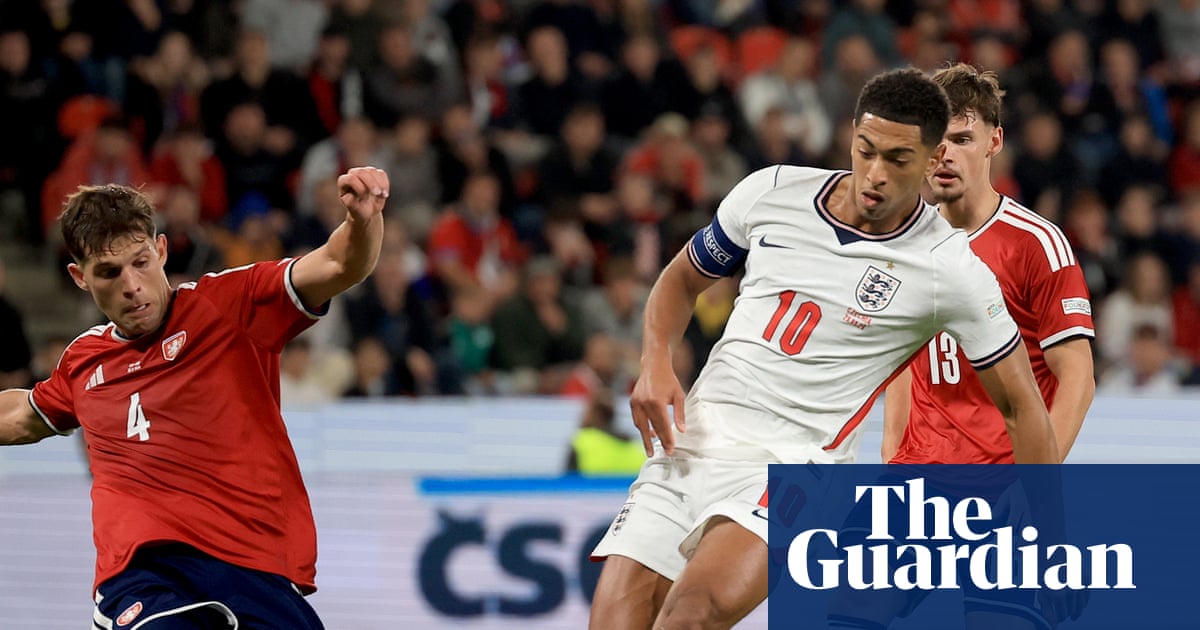
Photo: The Guardian
England sealed a 2-0 victory against Czechia in Prague on Nations League duty, with Harry Kane adding a late goal to maintain his remarkable scoring trajectory. Yet the manner in which the match concluded sparked a wider conversation about how the Three Lions will reshape their attacking play going forward. When Kane departed the pitch, Jude Bellingham stepped into the centre-forward role for the final stages, prompting Thomas Tuchel to publicly map out how England might evolve tactically in the years ahead.
How it unfolded
The visitors gained control of proceedings in the opening half when Czechia was reduced to ten men following an early dismissal. That numerical advantage translated directly into the opening goal through Anthony Gordon, with Trent Alexander-Arnold supplying the assist—a significant moment for the right-back, who had not featured for England since June 2025.
Kane then sealed the win with a sharp finish in the closing moments, before making way for Bellingham, who inherited the captain's armband and occupied the most advanced position through to the final whistle. The substitution came amid notable absences in the squad, with Ollie Watkins and Ivan Toney both overlooked for this set of fixtures.
With limited depth in the attacking department, Tuchel used the encounter to trial a different approach up front. The comfortable result also provided a swift response to Saturday's defeat against Spain, and three points moved England into second place in Group A3 of the Nations League.
Tuchel's vision for the future
Post-match, Tuchel directly addressed the transition at centre-forward and dismissed any notion of simply cloning Kane's role. The German manager was forthright about Kane's singular qualities, stressing that England's path forward lies in designing alternatives with fundamentally different characteristics. "You will not get another Harry Kane, first of all. We look for different solutions. We finished the game with Jude as a No 9. There will be someone else but it will not be Harry or a copy of Harry. We will find a solution when it comes to it but maybe not me. It might be another 10 years," he said.
Tuchel also explained his reasoning for deploying Bellingham in advanced attacking roles, viewing it as a means to increase width and bring England's two star assets into closer proximity tactically. "I like him as a [No] 9. Then he can contribute to both sides and overloads the sides and doesn't affect so much of the balance. We found a bit of a new role for him in the last match, as a central [No] 10, so he can go to both sides and it is more of a 4-2-3-1 than a 4-3-3 to have Harry and Jude closer together and to give them a chance to overload both sides," he explained.
Kane himself, who reunited with Tuchel at Bayern Munich after moving to the Bavarian club in 2023, offered his assessment of teammates' displays. He reserved particular praise for Alexander-Arnold's reinstatement to the starting eleven, highlighting the full-back's two-way excellence throughout the encounter in Prague and during the training camp. Kane stressed the importance of the defender continuing to show the coaching staff his commitment to the national team.
Why this matters
The succession question carries immediate weight given England's historical reliance on Kane as the focal point of attack. With 87 goals across 123 caps, his scoring record sits at a statistical threshold few contemporary forwards can approach, with the 100-goal milestone now in view. The simultaneous unavailability of Watkins and Toney threw into sharp focus the shortage of proven alternative options with genuine pedigree at international level.
Other candidates under consideration present far more modest international track records. Dominic Calvert-Lewin has managed four goals in 13 appearances at 29 years old, while Liam Delap, at 23, remains largely unproven in decisive moments for the senior side. Against this backdrop, reconfiguring the tactical system to function without dependence on a traditional lone number nine becomes a strategic imperative.
England confronts a generational replacement dilemma that has lingered since the post-Euro 2024 cycle, rooted in ongoing reliance on Kane's presence and finishing prowess. Bellingham's prior experience operating in advanced, mobile attacking roles at Real Madrid represents a viable pathway. Such flexibility allows the team to generate aggression and box penetration without becoming hostage to a traditional centre-forward stationed between the centre-backs.
What happens next
These tactical ideas face their next examination on Saturday, when England travels to Rijeka to face Croatia. Now positioned second in Group A3, the team must sustain their performance level and accumulate points to keep pace with the Nations League table.
The encounter in Croatia will reveal whether Tuchel deploys Bellingham again as a number nine or turns to alternative profiles in key moments. Meanwhile, the question remains whether Alexander-Arnold can consolidate his position at right-back following more than a year away from national team selection.
Rewritten from a story published by The Guardian. View original article ↗
AI-assisted translation of the original article in Portuguese. Read in Portuguese