Mancini rebuilds Italy in Nations League after Bosnia trauma
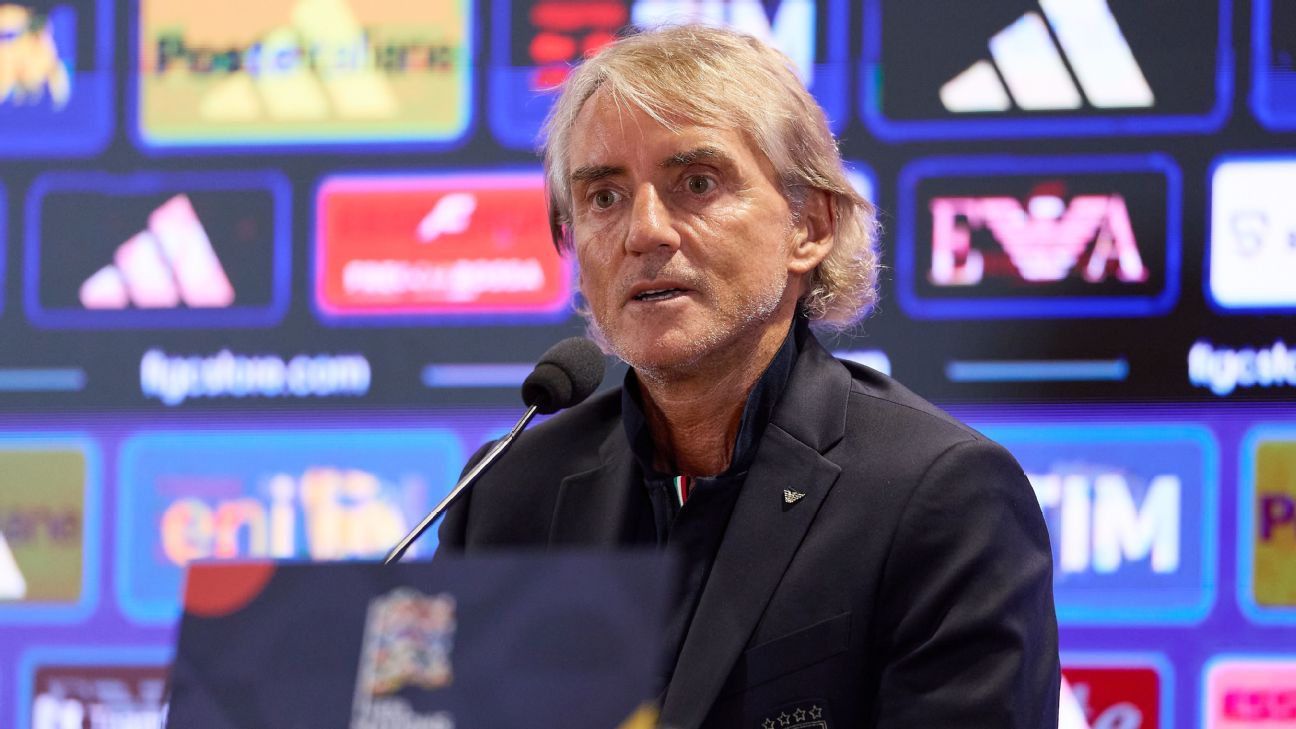
Photo: ESPN.com
Roberto Mancini returns to Italy's national team on a Friday laden with symbolism. Italy face Belgium in the UEFA Nations League, a match that marks not only the manager's return but his first competitive game in his second spell, and also the attempt by an entire nation to overcome recent trauma. "Tomorrow will be exciting as always, we hope to start well. We must immediately look beyond Bosnia," Mancini said. On the Belgian side, Mark van Bommel takes charge with just four days of preparation.
What happened
Italy never recovered from elimination by Bosnia-Herzegovina in the 2022 World Cup qualifiers. That failure cost Gennaro Gattuso his job, who departed in April that year. Five months later, in July, Mancini was called in to rebuild a team that, despite everything, remained fresh off the status of European champions—they had beaten England in the Euro 2021 final. The challenge was to restore lost confidence and pave the way towards the next objectives.
Belgium is also in a period of transition. Rudi Garcia was replaced by Mark van Bommel, who arrived with a tight schedule. The Belgian national team reached the quarter-finals at the previous World Cup, but the cycle that fuelled that campaign is running its course. Group A1 of the Nations League—which brings together Italy, Belgium, France and Turkey—leaves little room for trial and error.
The silence of Bosnia
The discomfort remains fresh in Italian consciousness. Gianluigi Donnarumma was clear about the team's emotional state: "They have been very tough days, I find it hard to talk about it. It was a strange and very long summer, but we have to start again." In the dressing room, before the match, Bosnia deserved only two minutes of discussion. "Have we talked about Bosnia? Zero. Only two minutes today, but there was no desire. The pain was too great to reopen that discussion," the goalkeeper explained.
That restraint reveals deliberate strategy. Mancini does not want the past to paralyse the present. But the silence also tells that the wound exists and remains sensitive—something the players acknowledge, even when they choose not to explore it verbally.
Mark van Bommel, for his part, faced a different constraint: "It's not easy to prepare the team in four days. We want the ball, and if we lose it, to win it back as soon as possible." The Belgian had tactical set-up to implement, but without time for refinement.
Why it matters
This match functions as a dual test. For Mancini, it is proof that the confidence placed in him was justified—that a second chance makes sense at a moment when Italy desperately needs stability. For van Bommel, it is a demonstration of capacity to rebuild quickly, a trait that shaped his experiences at Bayern and PSV.
The Nations League becomes the sole competitive laboratory available before Euro 2024 qualifying and the 2026 World Cup. Losing points here is not irreversible, but squandering learning moments is—and both national teams are at a stage where development time is scarce. Italy has never suffered so reputationally since 2010; two consecutive failures have altered mentalities and demand accelerated reconstruction. Belgium, meanwhile, faces the epilogue of a generational cycle and needs signals that it can evolve towards the next one.
What comes next
Italy and Belgium are in the most demanding group of the Nations League. The coming months will be filled with matches against France and Turkey, two opponents that offer no margin for improvisation. Each result contributes not only to the group standings but to the diagnosis of how each national team progresses under pressure and recovery at the same time. The calendar through to the end of the year will set the tone for ambitions in 2024 and 2026.
Rewritten from a story published by ESPN.com. View original article ↗
AI-assisted translation of the original article in Portuguese. Read in Portuguese